What is on the HSK 4 writing test?
HSK 4 writing is changing. The incoming HSK 3.0 test gives HSK 4 a 25-minute writing section with 6 questions: 5 picture-plus-word sentences, then one short essay of at least 80 characters. Most candidates still sit the current HSK 2.0 test. It sets 15 questions instead: 10 word-reordering items, then 5 picture-plus-word sentences.
On this page · 7 sections
The old and new HSK 4 writing formats
CTI's revised HSK 3.0 syllabus took effect in July 2026. The new Levels 1 to 6 exam launches worldwide on 13 December 2026. Most candidates still sit the older HSK 2.0 test today.
Both versions give you 25 minutes. The table below shows how their tasks differ.
| HSK 2.0 (current) | HSK 3.0 (from 13 December 2026) | |
|---|---|---|
| Time limit | 25 minutes | 25 minutes |
| Questions | 15 | 6 |
| Part 1 | 10 word-reordering items | 5 picture-plus-word sentences |
| Part 2 | 5 picture-plus-word sentences | One short essay of at least 80 characters |
Which grammar earns marks
A few grammar patterns earn marks in both formats: 把字句 (the 把 construction), 被字句 (the 被 passive), and comparisons with 比. Paired connectors matter too, such as 虽然 with 但是, 不但 with 而且, and 因为 with 所以.
Shufa practises the words inside these patterns the same way as every other word. First a guided pass, with the character's outline and stroke hints. Then a blind pass, written again from memory with no hints. 把 has 7 strokes.
Try HSK 4's real Part 1 task
HSK 3.0's Part 1 task is 看图,用词造句: look at a photograph, then write one grammatically correct sentence using the given word to match the scene. The sample paper's official answer key labels every model sentence 参考答案, a reference answer: one acceptable answer, not the only one. Describing a person in a photo splits into two useful angles: appearance (外貌), covering looks, clothing and posture, and action (行动), covering what they are doing. Pick one with a precise detail or verb instead of describing everything in the photo.
65. 结账, settle the bill
Question 65's photo shows a waiter in an apron standing across a counter from a female customer. 结账 is a verb for settling a bill, and the official 参考答案 reads 您好,请问能用信用卡结账吗?

66. 幅, a measure word for paintings
Question 66's photo shows a woman seated at an easel, brush in hand, painting on a canvas in front of her. 幅 is the measure word for paintings and pictures, and the model answer offers 他画了一幅美丽的风景画。
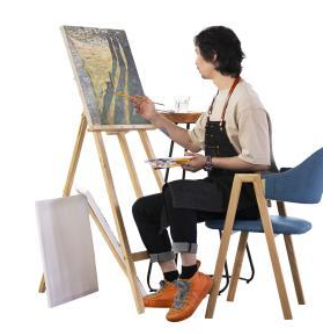
67. 文件, document
Question 67's photo shows a woman at a desk with a laptop open, holding up a sheet of paper. 文件 is the noun for a document, and the answer key gives 小张,去把这些文件复印一下。

68. 活泼, lively
Question 68's photo shows a young girl in a dress running with her arms swinging, captured mid-stride. 活泼 is the adjective for lively, and the answer key's example is 我的妹妹是一个活泼可爱的小姑娘。
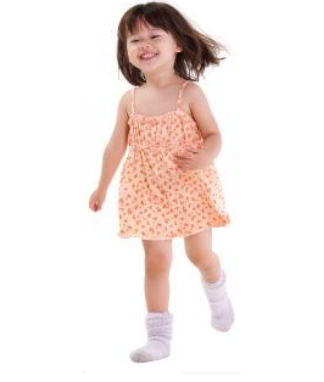
69. 正式, formal
Question 69's photo shows a woman in a white blazer and matching skirt standing with one hand on her hip, dressed for business. 正式 is the adjective for formal, and the published answer for it is 她今天要拍工作照,所以穿得很正式。

What the real essay prompt asks for
The sample paper's Part 2 prompt reads 请写一篇不少于80字的短文,介绍一下你最难忘的一次旅行, introducing your most unforgettable trip in that short essay. Its answer key marks this question (略), omitted, with no official model essay to copy from. This is the sample paper's own topic, not a guaranteed one: your real exam may set a different personal-experience prompt.
Before you write, cover six elements: who, when, where, what happened, why, and the result (记叙文的六要素, the six elements of narrative writing). A reader needs all six to follow the story. State them in your opening sentences, even briefly, before you move on to detail.
How to write it
These three techniques apply to any personal-experience topic, shown here with the sample paper's trip prompt. An 80-character essay rewards one clear detail over broad coverage. First, pick one angle: for a trip, that could be the scenery along the way, local customs, a person you met, or the feeling it left you with. Don't cover all four.
Second, reach for one concrete, specific detail instead of a vague adjective like 很美, "beautiful". "The sea glinted gold in the sunlight" (海水在阳光照射下闪着金光) gives a reader something to picture. "The scenery was beautiful" does not.
Third, end on the feeling the trip left behind rather than stopping the moment the story is over. "The memory never faded" (脑子里却留下了忘不了的记忆) makes a stronger closing line than one that only restates the last event.
What else do learners ask?
Does HSK 4 have writing?
Yes. HSK 3.0 gives HSK 4 a dedicated 25-minute writing section with 6 questions, ending in one short essay. It launches worldwide on 13 December 2026. Most candidates still sit the older HSK 2.0 test, which sets 15 questions instead, starting with 10 word-reordering items.
What does HSK 4 test in Part 1?
Under HSK 3.0, Part 1 is 5 picture-plus-word sentences: look at a photo, then write one sentence using the given word to match it. The older HSK 2.0 format uses 10 word-reordering items instead.
What about HSK 4 Part 2?
HSK 3.0 takes effect in July 2026 and launches worldwide on 13 December 2026. Under it, Part 2 is one short essay of at least 80 characters. The older HSK 2.0 format asks for 5 picture-plus-word sentence completions instead.
How many characters do you need to write for HSK 4?
The new HSK 3.0 syllabus requires HSK 4 candidates to write 400 characters by hand. The writing section tests a sample of that list directly, through the picture sentences and the short essay.
How do you pass HSK 4's writing test?
Plan a short beginning, middle and end before you write the essay, and keep your sentences short and simple. Attempting long or ambitious sentences raises your error rate. A short, correct sentence scores better than a risky longer one. Shufa applies that same discipline to HSK 4 writing practice, with a guided pass followed by a blind pass from memory.
How should you split your 25 minutes?
The sample paper sets no time limit per part, so this is a suggestion, not an exam rule. Give the 5 Part 1 sentences about 2 minutes each, then spend the rest of the time on the Part 2 essay. Leave a couple of minutes at the end to check your sentences and count your characters.
Sources
Practise it in Shufa
Shufa practises every word in HSK 4 with real stroke data: trace it once with stroke hints, then write it again from memory with the hints gone. It is free to use, with no account and no sign-up.